Introduction
Every growing business eventually faces the same question about its software: build it, or plug in something that already works?
For companies running custom applications on Laravel, this question comes up constantly — and the answer shapes how fast a product can move. This article covers the third-party integrations for Laravel applications that enterprise teams reach for most, why they consistently outperform custom builds, and how choosing the right ones can save months of engineering time.
Story Opening: The Sprint That Became an Afternoon
One of our clients came to us convinced a new feature would eat an entire sprint. Their team wanted to:
- Let customers pay for a subscription
- Send an instant email receipt after purchase
- Let customers search their own order history from a dashboard
On paper, that’s three separate systems — billing, email infrastructure, and search. The client had already blocked off two weeks of engineering time for it.
It took our team an afternoon.
Not because the requirements were small, but because none of them needed to be built from scratch. Laravel’s ecosystem already had a mature, well-documented integration path for every piece of it. The work wasn’t writing new infrastructure — it was wiring together tools that already existed and had already been battle-tested by millions of other applications.
The Pain Behind the Request
The client’s anxiety wasn’t really about the code. It was about everything a request like that implies for a lean team without specialized in-house expertise:
- Compliance risk — handling card data safely enough to satisfy PCI requirements
- Deliverability risk — building an email pipeline reliable enough that receipts don’t land in spam
- Performance risk — keeping search fast as the product catalog grows
For a small or mid-sized engineering team, each of those sounds like its own multi-week initiative. Worse, teams often only discover they’ve gotten one of these wrong after a customer complains — a support ticket about a missing receipt, a frustrated call about a payment that should have gone through, a manager asking why search takes three seconds to load.
That hesitation has a real cost:
- Teams over-invest, spending engineering time building infrastructure that already exists elsewhere.
- Teams under-invest, shipping something fragile that breaks under real usage.
Both outcomes slow the business down and quietly drain morale from the people responsible for shipping the feature.
Why Traditional, Custom-Built Solutions Fail
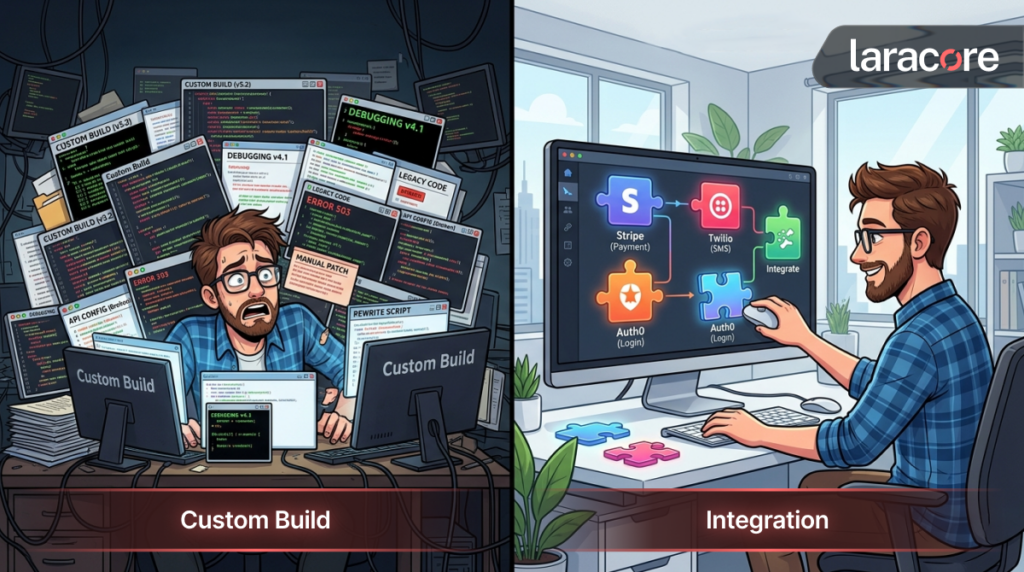
Building everything in-house feels like it offers more control. In practice, it usually introduces more risk than it removes:
- Custom payment code makes a team responsible for webhooks, retries, failed charges, and every subscription edge case that established payment providers have already solved over years of production use.
- A hand-rolled email pipeline puts deliverability, bounce handling, and spam scoring on the internal team instead of a specialist provider whose entire business depends on getting it right.
- A basic database search query works fine for a few hundred records and quietly breaks down at scale — usually right when the product starts gaining real traction and can least afford the slowdown.
None of this is unique to Laravel. It’s what happens whenever a team treats “build versus integrate” as a matter of preference instead of a genuine trade-off with real business consequences: unpredictable licensing costs, engineering hours spent maintaining infrastructure that isn’t core to the product, and scalability walls that appear right when growth accelerates.
How the Market Is Responding
The market solved this exact tension years ago. A few numbers make the shift clear:
- 98% of enterprises now use or are planning to use internal APIs, up from 88% in 2019, according to Gartner research cited via VentureBeat — a clear signal that composing applications out of proven services has become the default, not the exception.
- 5 million+ businesses now run on Stripe’s programmable financial services directly or through partner platforms, according to Stripe’s 2025 annual letter — underscoring how thoroughly tested that integration path has become.
- 558 million+ installs of the core Laravel framework package via Composer, according to Packagist, the official PHP package registry — a scale that only comes from a developer community building on shared, proven tooling instead of reinventing it project by project.
Enterprise buyers have noticed this shift too. Businesses evaluating custom Laravel development increasingly expect a vendor to explain not just what they’ll build, but what they’ll wisely choose not to rebuild.
The Solution: Ten Integrations Worth Knowing
For our client, the fix wasn’t three separate builds — it was three integrations Laravel already had a mature path for:
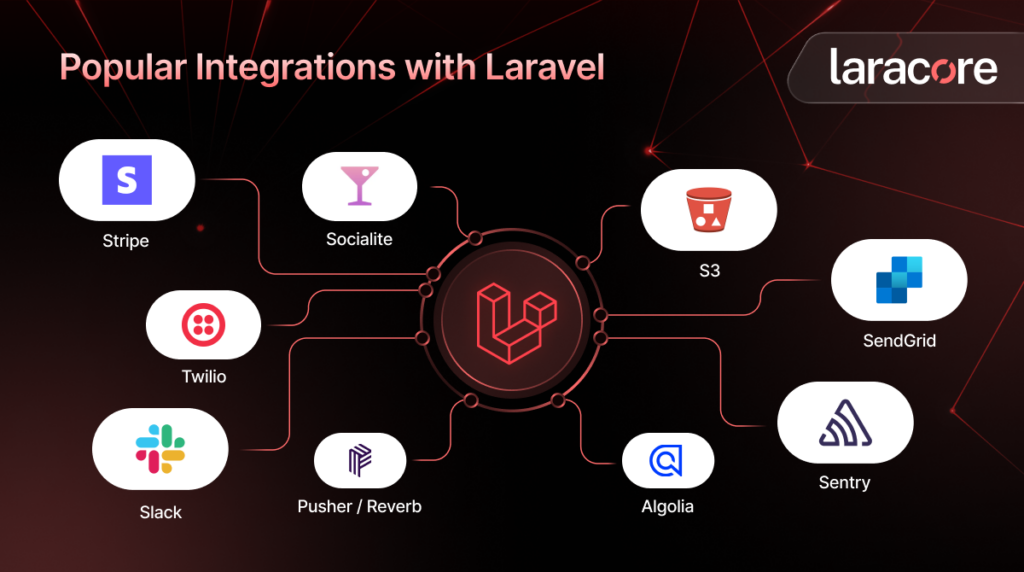
- Payments ran through Laravel Cashier, which wraps Stripe’s subscription billing into a fluent, expressive API for plans, trials, invoices, and webhooks.
- Email receipts ran through Laravel’s driver-agnostic mail layer, pointed at a transactional email provider like SendGrid, Postmark, or Mailgun — deliverability became the provider’s job, not an internal debugging exercise.
- Order search ran through Laravel Scout paired with Algolia, delivering instant, typo-tolerant search without touching raw SQL.
The rest of the list rounds out the integrations enterprise Laravel teams reach for most consistently:
- Laravel Socialite — removes signup friction by letting users authenticate with Google, GitHub, or LinkedIn instead of creating another password.
- AWS S3 (via Flysystem) — moves file uploads and backups to durable cloud storage using the driver already built into Laravel’s filesystem abstraction.
- Twilio — handles two-factor verification and SMS alerts through Laravel’s native notification channels.
- Sentry — hooks into Laravel’s exception handler, surfacing stack traces and release context before a customer has to report a bug secondhand.
- Pusher / Laravel Reverb — powers real-time features like live notifications, chat, and dashboards that update without a page refresh.
- Slack — routes admin alerts, failed job notices, or new-signup pings straight into a team’s existing workspace through a first-class Laravel notification channel.
For teams exploring how these fit into a broader engineering roadmap, as a top Laravel development company, we built around exactly this kind of integration-first thinking.
Business Examples Across Industries
- Healthcare — A patient scheduling platform built on Laravel used Twilio for automated appointment reminders and Stripe to collect co-pays at booking, cutting missed appointments significantly without adding staff for phone outreach.
- Retail & eCommerce — A growing online retailer paired Laravel Scout with Algolia to replace slow, database-driven product search, while Laravel Cashier handled subscription boxes and recurring billing — both live in production within weeks.
- Logistics — A freight coordination company moved shipping documents and proof-of-delivery photos to AWS S3 through Laravel’s filesystem abstraction, while Slack notifications alerted dispatch teams the moment a delivery exception occurred.
- Education — An online learning platform used Laravel Socialite to let students and instructors sign in with existing Google Workspace accounts, removing a major onboarding barrier for school-issued devices.
Future Outlook
This trend shows no sign of slowing. As more products lean on AI-driven features, usage-based billing, and increasingly automated workflows, the pressure to integrate rather than rebuild will only grow.
The specialists solving these problems — payment processors, search platforms, communications APIs — continue to out-invest what any single engineering team could realistically build and maintain internally. Laravel’s role in that future isn’t to compete with those specialists; it’s to remain the framework that makes plugging them in take an afternoon instead of a sprint, giving business and product teams more room to focus on what actually differentiates their application.
Frequently Asked Questions
Which third-party integrations are essential for Laravel?
The most common integrations include Stripe (payments), Socialite (login), AWS S3 (storage), SendGrid (email), Sentry (monitoring), Algolia (search), Pusher/Reverb (real-time features), and Slack (notifications). These are widely used, reliable, and easy to integrate with Laravel.
How does Laravel Cashier help with Stripe?
Laravel Cashier simplifies Stripe integration by handling subscriptions, billing, invoices, trials, and webhooks through a Laravel-friendly API, reducing development time and complexity.
Should I use a package or build custom integrations?
In most cases, use a trusted Laravel package. It saves development time, improves reliability, and reduces maintenance. Custom integrations are best for unique business requirements.
How much do Laravel integrations cost?
Costs depend on the integration’s complexity. Simple integrations like Slack or Socialite can take a few days, while payments, search, or enterprise integrations may require more time.
Can Laravel connect with CRMs and ERPs?
Yes. Laravel easily integrates with CRMs, ERPs, and other enterprise systems using APIs, queues, and middleware to automate business workflows.
How long does integration take?
Most standard integrations can be completed within a few hours to a few days. Larger projects involving data migration or extensive testing typically take longer.
What should I consider before choosing an integration?
Choose services with official or well-maintained Laravel packages, strong documentation, proven scalability, and long-term support to avoid costly migrations later.
Conclusion
The client’s app shipped payments, receipts, and search in a single afternoon — not because the requirements were small, but because none of them needed to be solved from scratch.
That’s the real lesson behind almost every conversation about third-party integrations for Laravel applications: it’s rarely about which specific tool to choose. It’s about knowing which parts of a product are genuinely worth building in-house, and which parts a proven, well-maintained integration has already solved better than an internal team could in the same timeframe.
Scoping new features for a Laravel application and not sure whether to build it or plug it in? Our team specializes in exactly this kind of decision.
From Custom Laravel Development Services to full Laravel Web Development Services, we help enterprise teams wire the right third-party tools into their product without over-engineering the parts that don’t need it.

With over 12+ years of experience shaping high-performing web and Laravel platforms, Faheem brings strategic expertise and proven stability to enterprise technology environments. At Laracore, he leads the delivery of scalable, performance-driven Laravel solutions designed to support long-term growth and global business demands.