The Question Nobody Wants to Answer in Sprint Planning
Here is a scenario that plays out inside engineering departments every month. A product team needs a feature live within the week. The request hits the backlog. The developer opens the codebase, realises nobody has touched that module in months, and quietly adds a note: ‘This might break payments — needs review.’ That review never happens. The feature ships. Three days later, a support ticket lands: checkout is behaving strangely for enterprise customers in a specific region.
Sound familiar? If your application runs on Laravel and your team has grown past a dozen engineers, the odds are high that you have at least one module that nobody fully owns, at least one update sitting in a branch marked ‘risky — do not merge without senior sign-off’, and a release cadence that makes the sales team nervous every time they promise a delivery date.
This is not a Laravel problem. This is a Laravel scaling problem — and the distinction matters enormously.
Why Laravel Scaling Breaks Differently for Enterprise
Laravel is, by most measures, a sensible choice for enterprise web applications in 2025. Its predictable release schedule, strong security defaults, and mature ecosystem make it a framework that engineering teams can rely on for years. The issue surfaces when growth in users, data volume, or team size is not met with a deliberate architectural response.
Consider what happens inside a typical product-led company when traffic begins to spike. The application that worked cleanly at a few thousand daily active users starts showing latency under load. Database queries that were fast enough become visible in monitoring dashboards. A campaign fires, traffic triples for six hours, and the ops channel fills with alerts. Someone scales the web tier manually. The crisis passes. Nothing else changes.
That incident is a warning. Most teams treat it as a one-off. Then it happens again — except the next time, a risky update was deployed two hours before the spike, and now nobody is certain whether the slowdown is traffic or the deployment. The blame bounces. Time is lost. Customer trust erodes quietly.

Five Pain Points That Signal Your Laravel App Is Not Ready to Scale
Pain Point 1: Bugs That Only Surface Under Load
Race conditions, memory leaks in long-running processes, and unindexed database queries are invisible at low traffic. They become expensive at scale. A fintech company running loan origination on a Laravel monolith discovered that a specific Eloquent query — perfectly functional during development — degraded to multi-second response times once concurrent sessions passed a threshold. The query had no index on the join column. It had been in production for over a year. Nobody caught it because nobody was watching query performance systematically.
Effective Laravel scaling demands query profiling as a standard part of the release process, not a post-incident forensic exercise.
Pain Point 2: Downtime That Becomes a Negotiation
Deployment-related downtime is a form of technical debt that compounds. Every time your team deploys and users experience interruption — even brief — you are training your customers to distrust your release cycle. For enterprise clients with SLA requirements, this is a commercial risk, not just an engineering inconvenience.
Zero-downtime deployment is achievable with Laravel today. Atomic symlink swaps, blue-green deployments, and managed platforms like Laravel Cloud — which launched in February 2025 with push-to-deploy from GitHub and automatic scaling — remove the infrastructure complexity that previously made this difficult for smaller teams.

Pain Point 3: Risky Updates That Freeze the Release Pipeline
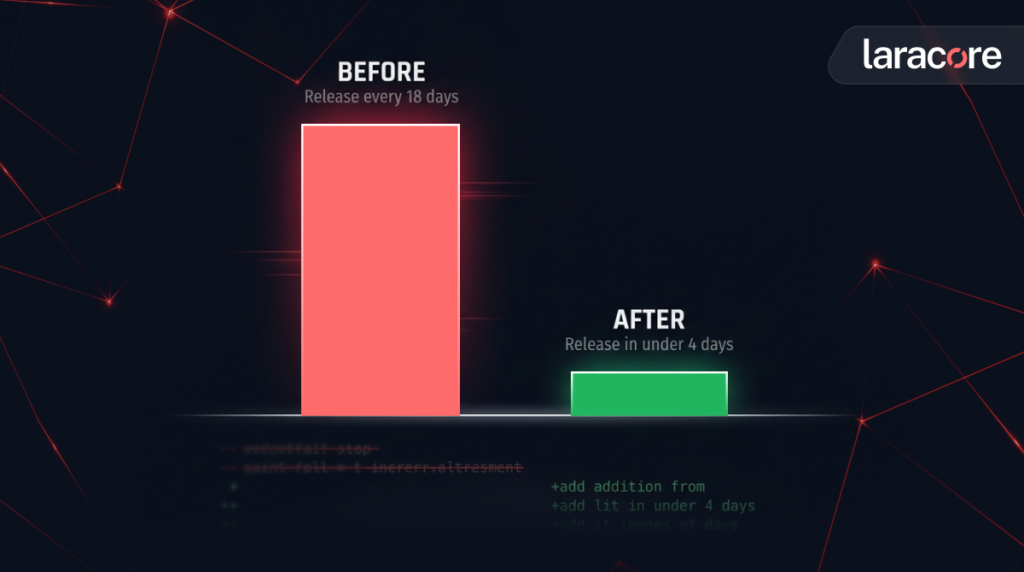
When a team labels a pull request ‘risky update’, it is usually because there is no confidence in the test coverage, no clear rollback path, or no certainty about what the change touches downstream. A B2B SaaS company with a Laravel CRM found that its release cycle had stretched to over two weeks — not because the engineers were slow, but because every deployment carried implicit risk that the team had never formally quantified. After decomposing the monolith into focused service modules and introducing feature flags, the same team shipped in under four days. Downtime on deployments dropped by over ninety percent.
The lesson: risky updates are usually a symptom of missing boundaries, not missing talent.
Pain Point 4: Slow Releases That Cost You Deals
Enterprise procurement cycles are long. The one thing that can accelerate a deal is a live proof-of-concept or a custom feature deployed quickly. When your Laravel scaling strategy is an afterthought, your release pipeline becomes a bottleneck that sales can feel. If a competitor can ship a requested integration in a week and your team needs a month to safely touch that module, the business consequence is direct and measurable.
Laravel’s queue system, Octane-powered request handling, and modular architecture are not just performance tools — they are commercial levers. Teams that use them correctly ship faster, which means they close faster.
Pain Point 5: Nobody Owns It
This is the quietest and most dangerous of the five. In a rapidly growing engineering team, modules accumulate without clear ownership. The payment gateway integration was built by someone who left last year. The reporting engine was ‘temporary’ and is now serving live data to enterprise dashboards. The notification service crashes sporadically and the on-call rotation has learned to restart it rather than fix it.
When nobody owns a module, nobody monitors it proactively, nobody advocates for its refactoring, and nobody considers it when planning upgrades. Laravel scaling without module ownership is building on sand.
What Strategic Laravel Scaling Actually Looks Like
The companies that get this right are not the ones with the biggest infrastructure budgets. They are the ones who made deliberate architectural decisions early enough to matter.
Horizontal scaling — distributing workload across multiple servers rather than adding capacity to a single machine — is supported natively by Laravel’s stateless design. Pair it with a Redis cluster for caching and session management, a read replica for reporting queries, and a properly configured queue system for everything asynchronous: emails, exports, notifications, and webhook dispatch.
Laravel Octane changes the performance equation further. By keeping the application warm in memory rather than bootstrapping it on every request, teams have seen response times drop from roughly a hundred and fifty milliseconds per request to under forty. For enterprise applications handling high-concurrency workflows, that improvement is not cosmetic — it is the difference between an application that feels fast and one that feels stressed.
On the deployment side, the answer to slow and risky releases is almost always the same: smaller changes shipped more frequently, with automated testing gates and feature flags that let the team decouple deployment from release. This approach does not require a microservices rewrite. A modular monolith — keeping the Laravel codebase intact but enforcing clear domain boundaries within it — delivers most of the isolation benefits with a fraction of the operational overhead.
The Ownership Question Is an Organisational One
Technology frameworks do not fix accountability gaps. If your engineering team does not have clear domain ownership mapped to specific modules, a Laravel upgrade or a new infrastructure layer will not solve it. The conversation about who owns what needs to happen at the team structure level before it can be enforced at the code level.
What Laravel scaling does is remove the excuse. When the framework gives you the tools to deploy without downtime, to process jobs asynchronously, to cache aggressively and scale horizontally, the remaining friction is usually human. Addressing the human side and the technical side compounds the improvement.
What Changes When You Get This Right
A logistics platform managing real-time freight tracking rebuilt its Laravel application with queue-first processing and Redis-backed caching. Before the changes, peak traffic hours triggered visible latency spikes that affected client dashboards. After, the same traffic volumes were processed without incident. The engineering team reported something just as valuable: confidence. They knew the system would hold, so they shipped more frequently, and the product moved faster.
That is what strategic Laravel scaling returns to an enterprise team — not just better uptime numbers, but the organisational confidence to move at the speed the market requires.
Where to Start
If you recognise more than two of the five pain points described above in your own application, the answer is not to delay. Begin with the simplest intervention: map module ownership across your codebase. Assign a named engineer or squad to each boundary. Then profile your top twenty database queries under load. Fix the indexes. Add a read replica if reporting queries are competing with transactional ones.
From there, introduce queue-based processing for every non-synchronous operation. Implement a deployment pipeline that supports atomic releases. These are not six-month projects. A focused team can make meaningful progress in weeks.
Laravel scaling is not about choosing between speed and stability. Done correctly, it is how you get both — and how you stop the next sprint planning session from turning into a quiet negotiation about what is safe to ship.
Reference Sources:
- Laravel Microservices Architecture & Cost Guide 2025 — abbacustechnologies.com
- Laravel Cloud Launch, Feb 2025 — medium.com / Megha Verma, Nerd For Tech
- Future-Proofing Enterprise Web Apps: Why Laravel Still Leads in 2025 — webmavens.com
- Zero-Downtime Deployment Strategies from a Laravel Development Company — 6b.systems
- Laravel Enterprise Production Ready 2026 — laracopilot.com

Faheem Hasan
With over 12+ years of experience shaping high-performing web and Laravel platforms, Faheem brings strategic expertise and proven stability to enterprise technology environments. At Laracore, he leads the delivery of scalable, performance-driven Laravel solutions designed to support long-term growth and global business demands.
With over 12+ years of experience shaping high-performing web and Laravel platforms, Faheem brings strategic expertise and proven stability to enterprise technology environments. At Laracore, he leads the delivery of scalable, performance-driven Laravel solutions designed to support long-term growth and global business demands.