The Idea That Looked Better on Paper
Every SaaS product starts with an idea. It may come from a business problem, repeated customer requests, or a process that takes too much time. One SaaS idea started with a simple goal: bring disconnected business processes into one platform with automation, dashboards, integrations, and better visibility. The feature list quickly grew with advanced reporting, AI recommendations, mobile apps, integrations, and automated notifications. Then potential customers were interviewed. Their biggest problem was much simpler. Teams were losing time working across spreadsheets, emails, and disconnected tools. They did not need another complicated platform. They needed one reliable place to manage an important workflow. The lesson was clear: building a SaaS application is not about turning every idea into a feature. It is about discovering which problem is important enough to solve first.Validate Before You Build
One of the easiest mistakes in SaaS development is starting development too early. Before starting SaaS product development, businesses should understand:- Who experiences the problem?
- How do they solve it today?
- What makes the current process frustrating?
- How often does the problem occur?
- What would make customers change their current solution?
An MVP Should Create Focus, Not More Features
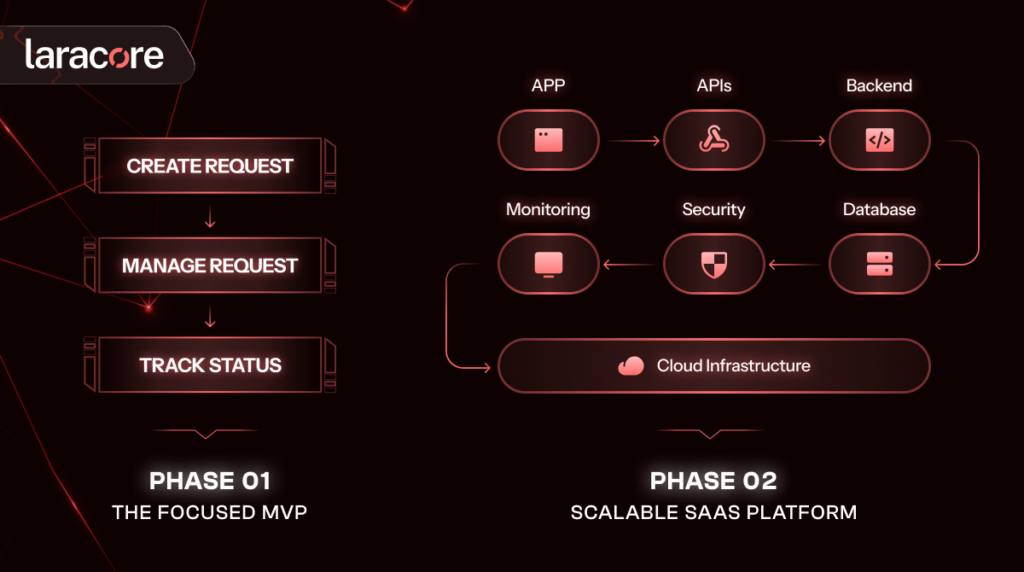
Once the problem is validated, the next challenge is deciding what the first version should include. Many SaaS projects become unnecessarily complicated when the MVP includes advanced analytics, AI automation, reporting, mobile apps, integrations, and multiple user roles. A better question is: “What is the smallest product that can solve the core problem and help us learn from real customers?” Imagine a SaaS platform for managing service requests. The long-term vision may include AI recommendations, advanced reporting, customer portals, mobile apps, and automation. The first version may only need:- Customers can create a request.
- Teams can manage the request.
- Customers can track its status.
Let Business Requirements Drive Technology
The better question is not: “Which framework should we use?” It is: “What does the business need the technology to support?” A SaaS application may start with a few customers and a simple workflow. Over time, it may need to support thousands of users, subscription plans, complex permissions, integrations, reporting, and automation. For businesses working within the Laravel ecosystem, Laravel SaaS Development can provide a practical foundation for products requiring structured business logic, authentication, APIs, queues, integrations, and administrative functionality. Technology should support today’s validated problem while leaving reasonable room for future growth. Build for today’s problem. Design with tomorrow’s growth in mind. Avoid unnecessary complexity. Leave room for the product to evolve.Architecture Decisions Become Expensive Later
Build the Core Workflow Before Perfecting the Interface
A common mistake is spending too much time making the product look finished before confirming that the core workflow actually works. For a SaaS product, the core workflow should come first. If the application manages projects, can customers create projects, assign work, track progress, and understand what happens next? If it manages support, can customers raise an issue, receive a response, track its status, and understand when it is resolved? These questions matter more than whether every page looks perfect. A successful SaaS application development process should make the most important customer journey reliable from beginning to end. Make the core workflow reliable before making everything else impressive.Real Users Will Change the Product
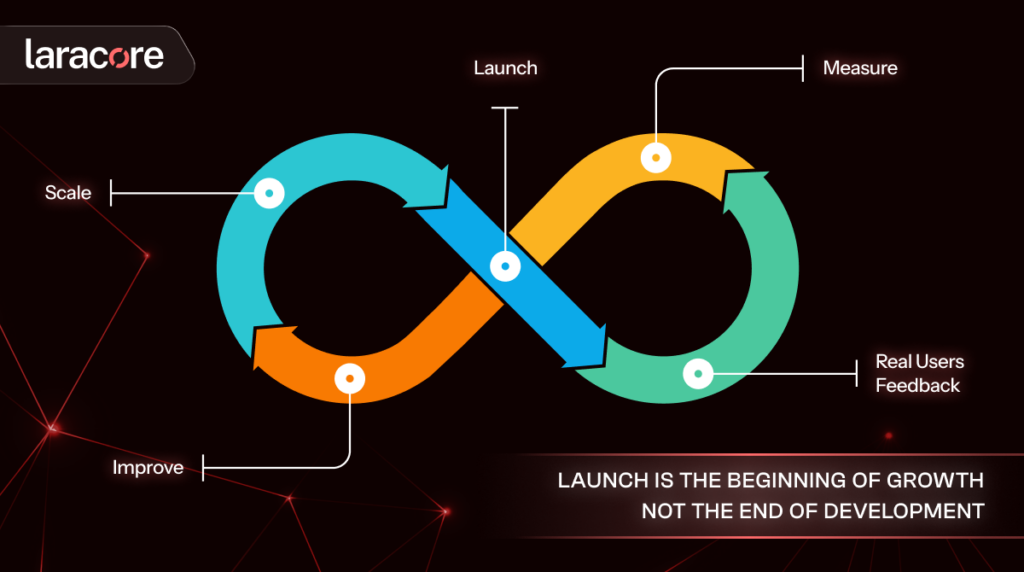 Internal testing can tell a team whether a product works as expected. Real customers reveal whether it works in the real world. A feature that seemed essential may never be used. A small improvement may become one of the most valuable parts of the product. Teams should observe:
- Where users stop.
- Which screens cause confusion.
- What users expect next.
- Which features they ignore.
- Where they repeatedly need help.
Launch Is the Beginning of a New Cycle
When the product goes live, development is not finished. After launch, businesses can measure whether users complete onboarding, reach the core value of the product, return after their first session, and get stuck in specific workflows. These signals should influence the next stage of development. This is why SaaS Application Development Services should not be viewed as a one-time effort. Successful SaaS products require ongoing attention to security, performance, monitoring, reliability, infrastructure, customer feedback, and product improvements. AWS SaaS architecture guidance also highlights capabilities such as onboarding, tenant management, identity, billing, metrics, and administration as important parts of a SaaS environment. This reinforces that a SaaS product is more than its customer-facing interface; the operational systems behind it must also support growth.The SaaS Development Journey Is a Sequence of Decisions
Successful SaaS development is a sequence of decisions:- Understand the problem.
- Validate whether it matters.
- Identify the customers experiencing it.
- Define a focused MVP.
- Choose technology based on business requirements.
- Establish an architecture that supports growth.
- Build the core workflow.
- Test with real users.
- Launch with clear success metrics.
- Improve based on evidence and feedback.
Conclusion: Don’t Just Build a SaaS Product. Build Something Worth Using.
Building a SaaS application from concept to launch is not a straight line from idea to code. It is a process of discovery. Understand the problem. Validate that it matters. Define a focused MVP. Choose technology that supports the product today while leaving room for tomorrow. Let real users shape the product. Treat launch as the beginning of a new learning cycle. Continue improving based on evidence and customer feedback. The strongest SaaS products are not necessarily the ones with the longest feature lists or the most advanced technology. They are the ones that solve a real problem, learn quickly, and evolve continuously. The real goal is not simply to take a SaaS application from concept to launch. It is to take it from concept to something customers genuinely value. Build the right problem. Build the right solution. Listen to the right people. Then keep improving.
Faheem Hasan
With over 12+ years of experience shaping high-performing web and Laravel platforms, Faheem brings strategic expertise and proven stability to enterprise technology environments. At Laracore, he leads the delivery of scalable, performance-driven Laravel solutions designed to support long-term growth and global business demands.
With over 12+ years of experience shaping high-performing web and Laravel platforms, Faheem brings strategic expertise and proven stability to enterprise technology environments. At Laracore, he leads the delivery of scalable, performance-driven Laravel solutions designed to support long-term growth and global business demands.