A marketplace can look simple from the outside.
A customer searches for a product or service, chooses an option, makes a payment, and receives what they need. On the other side, a seller receives the order, completes it, and gets paid.
But behind that simple experience is a much more complicated system.
A two-sided marketplace architecture has to serve two different groups at the same time while keeping their experiences connected. The buyer needs discovery, trust, and a smooth checkout. The seller needs onboarding, listings, availability, earnings, and reliable payouts.
The platform sits between both sides, making sure the right people can find each other and complete a transaction successfully.
Why Two-Sided Marketplaces Are Different
Traditional applications often have one primary user journey. A marketplace has at least two.
Think about a service marketplace. A customer searches for a professional, compares profiles, books a service, and pays. The professional, meanwhile, manages availability, receives the booking, communicates with the customer, and tracks earnings.
Both journeys depend on the same underlying platform.
That means the architecture needs to support:
- Separate buyer and seller experiences
- Role-based authentication and permissions
- Listings, categories, and search
- Matching and recommendations
- Orders or bookings
- Payments, refunds, and payouts
- Reviews and ratings
- Messaging and notifications
- Admin and moderation tools
The challenge is not simply building two dashboards. It is connecting both sides without making either experience complicated.
According to Stripe’s 2026 marketplace strategy guide, two-sided marketplaces depend on balancing supply and demand, with search, discovery, payments, onboarding, verification, and risk management becoming important parts of the platform as it grows.
Designing the Core Marketplace Architecture
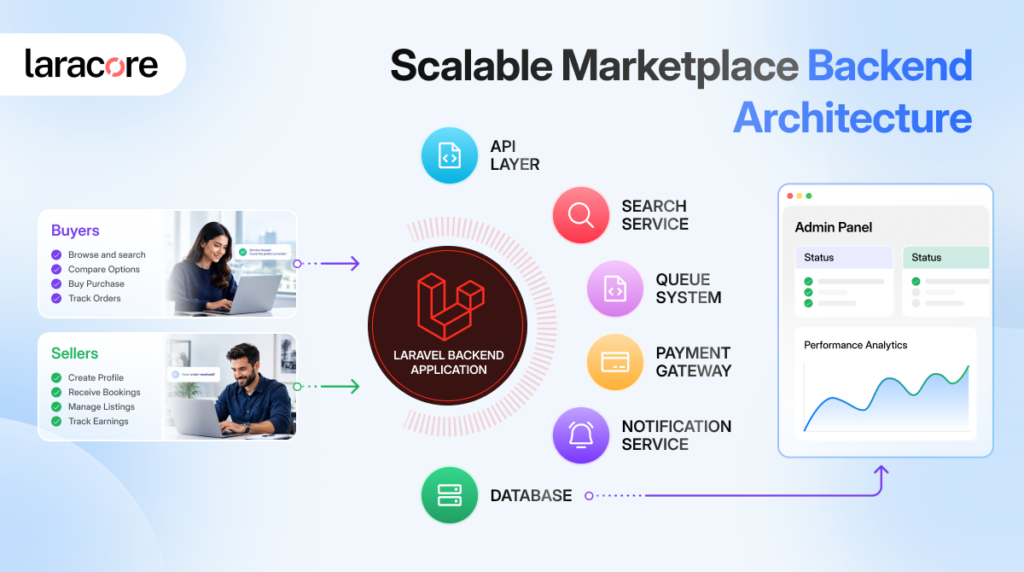
A practical architecture usually starts with a shared backend and clearly separated user roles.
The buyer application communicates with services responsible for search, profiles, orders, payments, and notifications. The seller side uses the same core system but has different permissions and workflows.
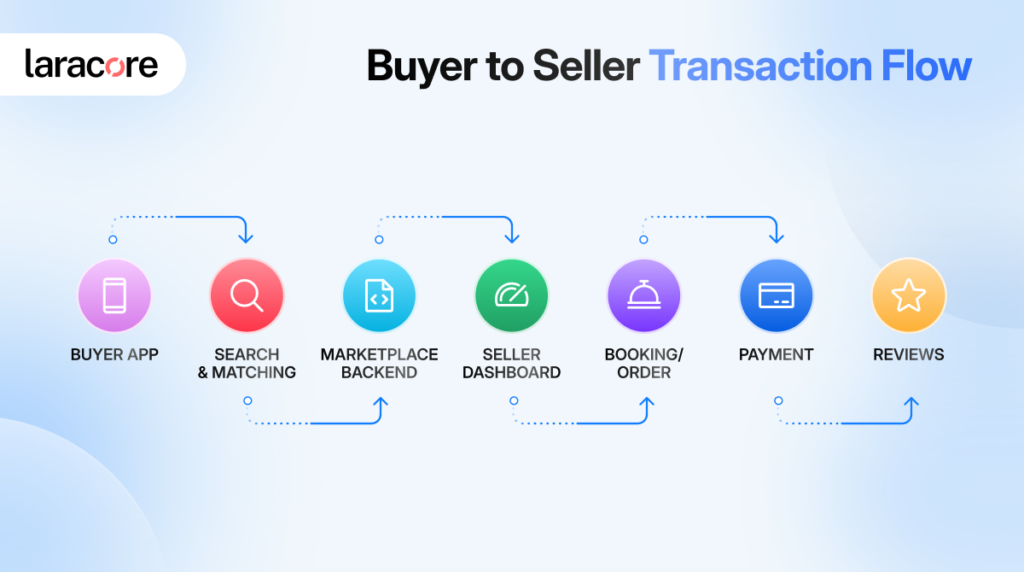
At the center is the marketplace backend.
It manages the business rules that connect both sides:
Buyer → Search → Matching → Seller → Transaction → Payment → Fulfillment → Review
This flow should be designed carefully because a problem at any stage can affect both users.
For example, if a seller’s availability is not updated correctly, a customer may book an unavailable slot. If payment succeeds but the booking is not created, the platform now has a financial and customer-support problem.
Search and Matching
As the number of sellers grows, simply displaying listings is no longer enough.
The platform needs structured categories, filters, location data, pricing, availability, ratings, and potentially ranking logic to help buyers find relevant options.
Stripe also highlights search and discovery, along with measures such as search-to-booking rates and response times, as useful indicators of marketplace health.
Payments Need Their Own Architecture
Payments become more complicated when money moves between multiple parties.
A standard ecommerce checkout might simply charge the customer. A marketplace may need to collect a platform fee, transfer money to a seller, manage refunds, handle disputes, and track payout status.
For example:
Customer pays $100 → Platform fee $10 → Seller receives $90
The exact flow depends on the business model, location, tax requirements, and payment provider.
Stripe explains that marketplace payment infrastructure needs to manage fund routing, fee collection, payouts, seller verification, and multiparty transactions.
This is why payment logic should not be treated as a small feature added near the end of development.
Building for Scale From the Beginning
A marketplace may start with a few hundred users and still need an architecture that can evolve as transaction volume increases.
This does not necessarily mean starting with an unnecessarily complex microservices system.
A well-structured Laravel application can provide a strong foundation for many marketplace products when its modules, database relationships, queues, APIs, and permissions are designed properly.
For example, Laravel’s official documentation explains that queues can move time-consuming work away from normal web requests, improving responsiveness while supporting backends such as Redis, Amazon SQS, and relational databases.
This can be useful for marketplace tasks such as:
- Sending notifications
- Processing seller onboarding
- Generating invoices
- Updating search indexes
- Sending emails
- Processing background reports
Trust Is Part of the Architecture
A marketplace is built around transactions between people or businesses that may not know each other.
That makes trust an architectural concern, not just a marketing feature.
Profiles, verification, reviews, reporting, dispute handling, moderation, secure payments, and clear transaction records all contribute to the experience.
The admin side also becomes increasingly important as the marketplace grows. Administrators may need to manage sellers, investigate disputes, review listings, monitor transactions, and handle account restrictions.
A marketplace architecture therefore needs to think beyond the buyer and seller interfaces.
It needs a third layer: platform control.
Where Laravel Fits Into Marketplace Development
Laravel can be a practical choice for building the backend of a marketplace because it provides structured routing, authentication, database tools, queues, APIs, notifications, and other components required for business applications.
The important part is not simply choosing Laravel. The architecture around it needs to reflect the marketplace’s actual business model.
A food marketplace, B2B supplier platform, freelancer marketplace, and rental platform may all use similar foundations, but their matching, availability, payments, and fulfillment workflows can be very different.
That is where Custom Laravel Development Services become valuable.
A carefully planned Laravel Web Development Services approach can create separate buyer and seller workflows while keeping shared business logic centralized and maintainable.
Build a Marketplace That Can Grow With the Business
The strongest marketplace architecture is not the one with the most technologies. It is the one that keeps the buyer experience, seller operations, transactions, and platform management connected as the business grows.
If the foundation is planned correctly, new features such as recommendations, subscriptions, advanced analytics, automated matching, or mobile applications can be added without rebuilding the entire platform.
For businesses planning a marketplace from the ground up, Laracore provides Laravel Development Services, Laravel Web Development, and Custom Laravel Development Services designed around specific business workflows.
Planning a two-sided marketplace? Talk to Laracore to design a scalable Laravel architecture that connects buyers, sellers, payments, and operations in one reliable platform.

With over 12+ years of experience shaping high-performing web and Laravel platforms, Faheem brings strategic expertise and proven stability to enterprise technology environments. At Laracore, he leads the delivery of scalable, performance-driven Laravel solutions designed to support long-term growth and global business demands.