The Task Was Completed. But the Product Still Had a Problem.
The development ticket was marked complete.
A business had hired a contractor to fix a performance issue in its SaaS application. The developer reviewed the assigned code, made the necessary changes, tested the fix, and closed the task. From a project management perspective, everything looked successful. The work was delivered, the deadline was met, and the business moved on to the next priority.
A few weeks later, another part of the application started behaving unexpectedly.
The problem was not necessarily caused by poor development work. The contractor had solved the issue described in the original task. The problem was that the developer had not been involved long enough to understand how that part of the application connected to the rest of the product. Another developer had previously built a related feature, and a third person was responsible for an integration that depended on the same data.
Each developer had completed their assigned work.
But nobody had the full picture.
This situation is common in software projects where development is organized entirely around individual tasks. A business hires someone to fix a bug, another person to build an API, and someone else to improve a user interface. Every assignment may be completed successfully, yet the product can still become harder to maintain because the people working on it do not share the same long-term understanding of the system.
This is where dedicated developers can offer a different approach.
The advantage is not simply that dedicated developers are better programmers than contractors. That would be an unfair and inaccurate comparison. Many contractors are highly experienced and can deliver excellent work. The real difference is the level of continuity, product knowledge, and ownership that comes from having developers who stay closely involved with the same product over time.
For a growing SaaS platform or long-term software product, that difference can become increasingly important.
Task-Based Contractors Focus on Assignments. Dedicated Developers Understand the Product.
Task-based development can be useful when the requirement is clearly defined and isolated. A company may need a one-time migration, a specific integration, a short-term bug fix, or a specialized technical service. In situations like these, hiring someone to complete a particular assignment can be practical and efficient.
The challenge appears when the same model is used to build and maintain a product that is constantly changing.
A software application is rarely just a collection of independent tasks. The database affects the API. The API affects the frontend. Authentication affects permissions. Billing affects subscription management. A change in one workflow can influence reporting, notifications, integrations, and customer support.
A developer who has worked with the product for months or years is more likely to understand these relationships. They may know why a particular database structure was selected, which parts of the application are sensitive, how customers actually use the product, and which technical decisions were made because of earlier business requirements.
A task-based contractor may see one ticket.
A dedicated developer sees the product around that ticket.
That distinction changes the way technical decisions are made. Instead of asking only, “How can this task be completed?” a developer with deeper product knowledge is more likely to consider, “How will this change affect the rest of the application?”
That broader perspective can help businesses avoid solving one problem while accidentally creating another.
Context Becomes More Valuable as the Product Grows
Every developer needs time to understand a new codebase. They need to learn the architecture, identify the main business rules, understand the development workflow, and become familiar with the tools and integrations involved in the project.
This learning period is often treated as a normal part of onboarding, but it still has a cost.
When a business frequently changes developers, that learning process happens repeatedly. A new person joins the project, spends time understanding the application, completes a few tasks, and eventually moves on. The next developer then starts the same process again.
The product may continue moving forward, but the team keeps paying the cost of rebuilding context.
There is evidence that this type of knowledge friction is not a small issue for software teams. In Stack Overflow’s 2024 Developer Survey, 61% of professional developers surveyed said they spend more than 30 minutes per day searching for answers or solutions to problems, while 30% reported that knowledge silos affect their productivity ten or more times per week. These figures do not prove that dedicated developers automatically perform better, but they do illustrate the practical cost of information gaps and fragmented knowledge inside development environments.
A dedicated developer takes a different path. The longer they stay involved, the more they learn about the application and the business behind it. They begin to understand not only how the code works but also why certain decisions were made.
That knowledge becomes increasingly valuable.
Imagine a SaaS platform that manages customer subscriptions. A new task may simply say, “Add a new enterprise subscription plan.” A developer who is unfamiliar with the product may focus on adding the plan to the database and displaying it on the pricing page.
A dedicated developer may immediately think about the wider impact. They may consider subscription upgrades, billing rules, permissions, invoices, reporting, API responses, customer notifications, and existing customers who are already on older plans.
The task itself has not changed.
The context around the task has.
That is one of the biggest advantages of continuity in software development.

The Cost of Re-Explaining the Same Product
There is a hidden cost in constantly changing development resources: the product has to be explained again and again.
Someone needs to explain how the authentication system works. Someone needs to describe the relationship between the main database tables. Someone needs to explain why a particular integration was built in a certain way. Someone needs to tell the new developer which parts of the system should be changed carefully because they affect critical workflows.
Sometimes this information exists in documentation.
Sometimes it exists in project management tools.
And sometimes it exists only in the memory of the developer who originally built the feature.
This becomes a problem when that person leaves.
A dedicated development team can reduce this dependency because product knowledge is built continuously rather than repeatedly recreated. Developers who remain involved over time can document important decisions, understand the history of the codebase, and help transfer knowledge across the team.
The importance of accessible knowledge is also reflected in developer experience research. Atlassian’s 2025 State of Developer Experience research, based on a survey of 3,500 developers and managers across six countries, identified finding information, adapting to new technology, and context switching between tools among the major sources of developer friction. The research also reported that 50% of developers lose 10 or more hours per week to non-coding work, including organizational inefficiencies.
For a business, this creates an important distinction.
A dedicated team does not eliminate the need for documentation or good processes. In fact, those practices become even more important as the product grows. But when developers remain engaged with the same product, documentation and shared knowledge can be built around an established understanding rather than recreated from scratch every time someone new joins.
The goal is not to make a product dependent on one developer.
The goal is to build a team that collectively understands the product well enough that knowledge continues to exist even as individual responsibilities change.
Dedicated Developers Can See Beyond the Current Ticket
A task-based engagement naturally focuses attention on the immediate assignment. If the requirement is to fix a specific bug, the developer’s responsibility may be to fix that bug. If the task is to build an integration, the developer may focus on completing the integration.
That focus can be useful.
But long-term product development requires a wider view.
A dedicated developer who understands the product roadmap can think about how today’s technical decision may affect tomorrow’s requirements. They can ask whether a database structure will support future growth, whether an API can accommodate another integration later, or whether a quick workaround is likely to become technical debt.
This does not mean every feature needs to be over-engineered.
In fact, good developers should know when a simple solution is the right solution. The difference is that they can make that decision with more context.
They understand what the business is trying to achieve, what the customers need, and where the product is likely to go next.
That combination of technical knowledge and product context can lead to better decisions.
Ownership Changes the Conversation
There is an important difference between completing work and taking responsibility for the outcome.
A developer assigned to a single task may reasonably measure success by whether the requirement was completed. A dedicated developer working closely with the product team is more likely to think about whether the solution actually improves the product.
That difference becomes especially visible when something unexpected happens.
A customer reports a problem after deployment. A third-party API changes. Performance starts slowing down. A new feature causes an unexpected side effect.
A developer who already understands the application can often start investigating immediately. They know the architecture, remember recent changes, and understand the business workflow involved.
A developer who has never worked on the system may first need to understand how everything fits together before identifying where the problem started.
Again, the difference is not necessarily talent.
It is familiarity.
The more context a developer has, the less time they need to spend figuring out what the system is doing before they can focus on why it is doing it.
That can be especially important for products where reliability and speed of response directly affect customers.
Dedicated Developers Become Part of the Product’s Memory
Every software product has a history.
There are reasons behind technical decisions, product decisions, and architecture choices. Some were made because of customer requirements. Others were compromises made because of time, budget, or technology limitations.
The code can show what the application does.
It does not always explain why it was built that way.
Dedicated developers who stay involved over time become familiar with that history. They remember why a particular workaround exists, which technical debt is intentional, and which areas of the system should eventually be redesigned.
This historical knowledge can prevent teams from repeating old mistakes.
For example, a new developer may see an unusual piece of code and decide to “clean it up” because it looks unnecessarily complicated. A developer with historical context may know that the code exists because a third-party service behaves unpredictably or because an earlier version of the product had a specific customer requirement.
Without context, the change may look like an improvement.
With context, the team can make a more informed decision.
This is one reason long-term product knowledge is difficult to measure but valuable to maintain.

Communication Gets Faster When Developers Understand the Business
Product discussions become much easier when developers already understand the business context.
Instead of explaining every detail behind a requirement, the product team can focus on the decision itself.
For example, a product manager might say that enterprise customers now need multiple billing contacts. A developer who already understands the subscription and billing architecture can immediately start thinking about how that requirement affects user roles, permissions, invoices, notifications, and account management.
A developer with no previous product context may need to start with a much longer conversation.
What is an enterprise customer?
How does billing work?
Where are billing contacts stored?
How are permissions assigned?
What happens when the subscription changes?
The difference may not seem significant in one conversation.
Across dozens or hundreds of product decisions, however, this repeated explanation can slow the entire development process.
A dedicated developer does not simply receive instructions.
Over time, they become capable of contributing to the discussion. They can identify risks, challenge assumptions, suggest alternatives, and explain the technical consequences of product decisions.
That is when a developer becomes more than a resource assigned to tickets.
They become part of the product team.
Dedicated Does Not Mean One Developer Has to Do Everything
The dedicated development model is sometimes misunderstood as hiring one developer and expecting that person to handle every technical responsibility.
That is not what a strong dedicated development team needs to look like.
Depending on the product, a dedicated team may include backend developers, frontend developers, QA engineers, DevOps specialists, UI/UX designers, project managers, and technical leads. The important difference is that these people remain aligned with the same product and its long-term objectives.
They build shared knowledge.
They follow common development practices.
They understand the product roadmap.
They communicate with each other.
They know how their work affects the wider system.
This is particularly useful for products that require continuous development. Instead of constantly bringing in new people for unrelated tasks, the business can build a team that becomes increasingly familiar with the product.
The value is not simply the number of developers involved.
The value is the knowledge the team accumulates together.
Where Task-Based Contractors Still Make Sense
The argument for dedicated developers should not be interpreted as saying that task-based contractors are always the wrong choice.
There are situations where a task-based engagement is exactly what a business needs.
A company may need a specialist for a short-term security assessment. It may need help with a one-time migration or a specific integration. It may need additional development capacity for a temporary period or require expertise that does not make sense to maintain internally.
In these cases, hiring someone for a defined assignment can be practical.
The real question is the nature of the product and the work.
If a business is building a long-term SaaS platform that will continue changing based on customer feedback, the development model needs to support that continuity. If the application is strategically important to the business, the cost of losing product knowledge can be much higher than the initial savings from treating every requirement as an isolated task.
The decision should therefore not be based only on hourly rates or the cost of completing the next ticket.
It should be based on how much ongoing product knowledge the project requires.
The Hidden Cost of Treating Every Task as a Separate Project
Task-based development can look affordable at first.
The business defines the requirement, hires someone to complete it, and pays for the work.
But the real cost may appear later.
A new developer needs to understand the codebase. A feature introduces unexpected side effects. Documentation is incomplete. Different developers use different approaches. Technical decisions are made without understanding the wider product.
These costs may not appear as separate line items on an invoice.
Instead, they show up as slower releases, longer debugging cycles, repeated onboarding, technical debt, and delays in making product decisions.
Software development performance is not only about how much work a team completes. DORA’s research emphasizes the importance of measuring both delivery speed and stability, including metrics such as deployment frequency, lead time for changes, change failure rate, and time to restore service. This broader view is useful because it shifts attention away from simply counting completed tasks and toward how reliably a team can deliver and operate software over time.
This is where the difference between task completion and product ownership becomes clear.
The goal is not to complete the highest number of tickets.
The goal is to deliver valuable changes without creating unnecessary problems elsewhere in the system.
Dedicated Developers Can Become More Effective Over Time
A dedicated developer may not be the fastest contributor during the first few weeks of a project.
There is always a learning curve.
The developer needs to understand the application, the business, the customers, and the team’s processes.
But something changes with time.
The developer becomes familiar with the codebase. They recognize patterns. They understand the architecture. They remember previous decisions. They know where problems are likely to occur.
A feature that once required extensive investigation may later be understood much faster because the developer already knows how the relevant parts of the system work.
This is where continuity can compound.
The team is no longer starting from zero with every new requirement.
It is building on knowledge accumulated from previous work.
DORA’s research similarly highlights that strong software delivery depends on the capabilities and environment surrounding developers, not simply on individual productivity. The 2025 DORA research describes AI as an amplifier of existing team and system dynamics, reinforcing the broader point that tools and individual effort work best when the underlying team practices, workflows, and foundations are strong.
A dedicated developer does not automatically create a high-performing team.
But continuity gives the team an opportunity to build the shared context and working practices that make better performance possible.
The Real Question Is Not “Who Can Build It?”
When businesses hire developers, the first question is often:
“Who can complete this task?”
That is a reasonable question for a short-term requirement.
But long-term software products require another question:
“Who can understand this product and help it evolve?”
The difference between these questions is subtle, but it changes the way development is approached.
A task-focused model is concerned with completing the requirement in front of the team.
A dedicated development model is more focused on understanding how that requirement fits into the larger product.
Neither approach is universally right or wrong.
The right choice depends on the nature of the work.
But when a business is building a SaaS platform, a customer-facing application, or a product that will continue evolving for years, continuity becomes much more valuable.
The product will change.
Customers will change.
Requirements will change.
Technology will change.
The team needs enough context to understand those changes and respond to them without constantly rebuilding its understanding of the system.
That is where dedicated developers can create their strongest advantage.
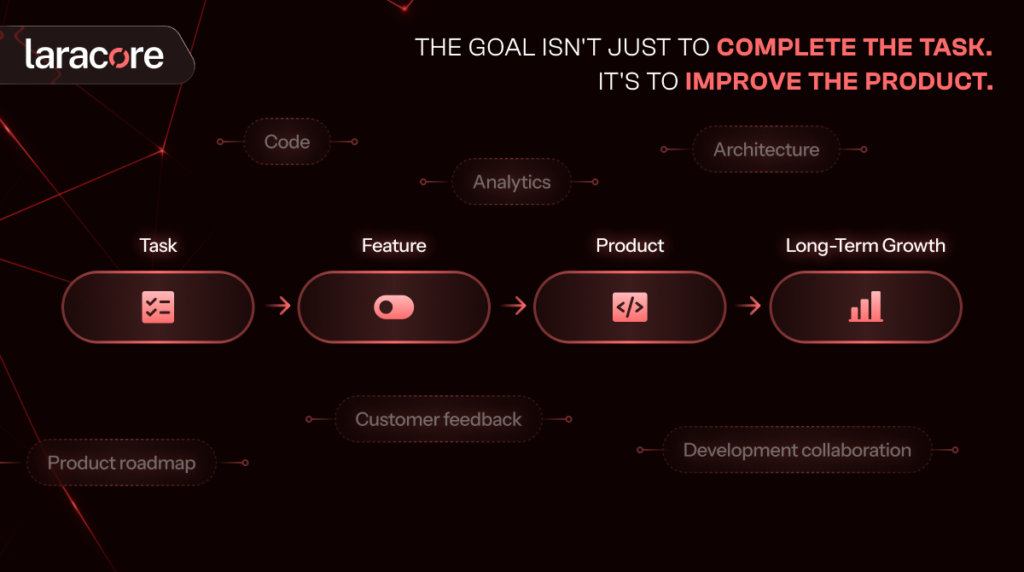
When a Dedicated Development Team Becomes the Better Choice
A dedicated development model may be worth considering when the product is expected to evolve over a long period and the development team needs to understand both the technology and the business behind it.
It can be particularly valuable when:
- The application requires continuous feature development.
- The product roadmap changes based on customer feedback.
- The architecture is complex or expected to evolve.
- Technical decisions have long-term consequences.
- The business needs developers to understand its industry or domain.
- The product requires ongoing maintenance and optimization.
- Multiple developers need to work toward shared product goals.
- The application is strategically important to the business.
In these situations, the value of a dedicated team is not simply the number of development hours available.
It is the accumulated knowledge that makes those hours more valuable over time.
The team learns the product.
The product team learns how the developers think.
Communication becomes easier.
Technical decisions become more informed.
And the development process becomes less about starting from scratch with every new task.
The Best Development Model Depends on the Product
There is no single development model that works for every business.
Task-based contractors can be an excellent choice for clearly defined, isolated requirements. Dedicated developers can be a better fit for products that require ongoing development, continuous learning, and long-term technical ownership.
The important thing is to choose the model based on the product’s lifecycle rather than simply the immediate cost of the next task.
If the work is isolated and unlikely to affect the rest of the system, a task-based approach may be perfectly reasonable.
If the product is evolving every month, customer feedback is continuously changing priorities, and today’s technical decisions will affect tomorrow’s roadmap, continuity becomes more valuable.
The right question is therefore not simply, “How much will this developer cost?”
It is:
“How much product knowledge will this development model help us build and retain?”
That is a much more useful way to think about long-term software development.

With over 12+ years of experience shaping high-performing web and Laravel platforms, Faheem brings strategic expertise and proven stability to enterprise technology environments. At Laracore, he leads the delivery of scalable, performance-driven Laravel solutions designed to support long-term growth and global business demands.