What if the biggest risk to your product isn’t a cyberattack, a bad hire, or a failed launch — but a version number nobody is paying attention to? That is the quiet reality for hundreds of enterprise engineering teams right now. The application is running. Users are logging in. Revenue is coming in, and somewhere in a Jira board nobody reviews, there is a ticket titled “Laravel upgrade — discuss Q3” that has been pushed to Q4 for the third consecutive year. This is not a PHP problem. This is a decision-making problem. And the longer it sits, the more expensive it gets. What Is Laravel Migration — And Why Does It Matter More in 2026? Laravel migration, in the context of this conversation, means one specific thing: moving your application from an older, unsupported version of the Laravel framework — most commonly Laravel 6, 7, or 8 — to a version that is actively maintained, secure, and capable of supporting modern infrastructure. Laravel versions 6, 7, 8, 9, 10, and 11 have all reached end of life and no longer receive security updates. That list is not a warning from the future. It is the present state of your stack — if you have not already moved. Laravel’s Long Term Support channel actively supports a version for two years with bug fixes and security patches, then shifts to a security-only phase for one additional year — three years total. After that, you are on your own. No patches. No fixes. No cavalry. The question is not whether a Laravel migration is necessary. The question is: what is the actual cost of waiting, and who in your organization owns the answer?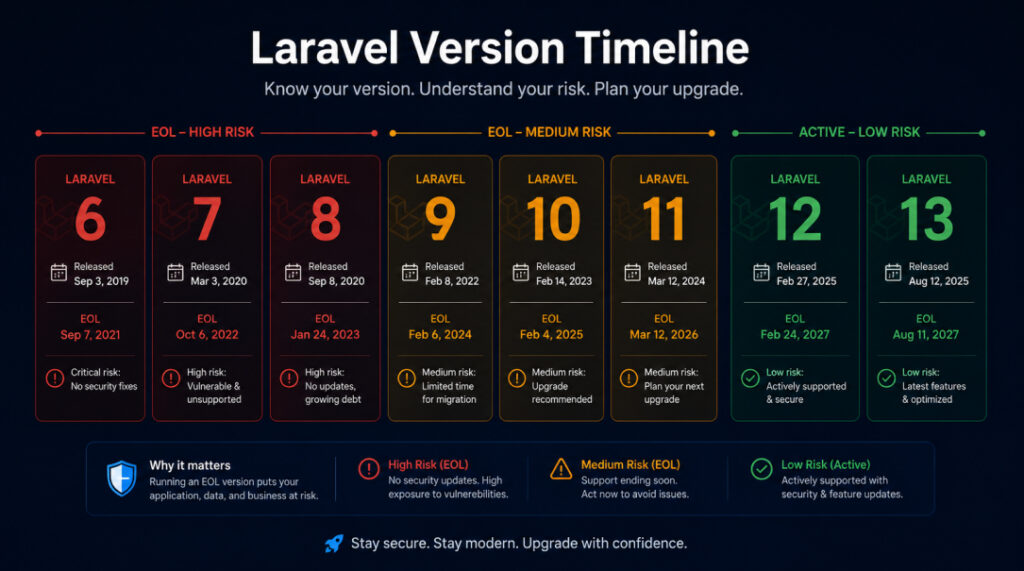 Here is where it gets uncomfortable for enterprise teams. Laravel 6 was released in September 2019 and was the framework’s first LTS release under semantic versioning. Laravel 7 followed in March 2020. Laravel 8 arrived in September 2020. At the time, these felt modern, stable, and more than adequate. Laravel 7 and 8 are no longer supported with security fixes or PHP 8.2+ compatibility. Staying on these versions opens your application to vulnerabilities, slows development, and blocks access to modern tools like Vite, Octane, and typed routes. This creates a compound problem for engineering teams: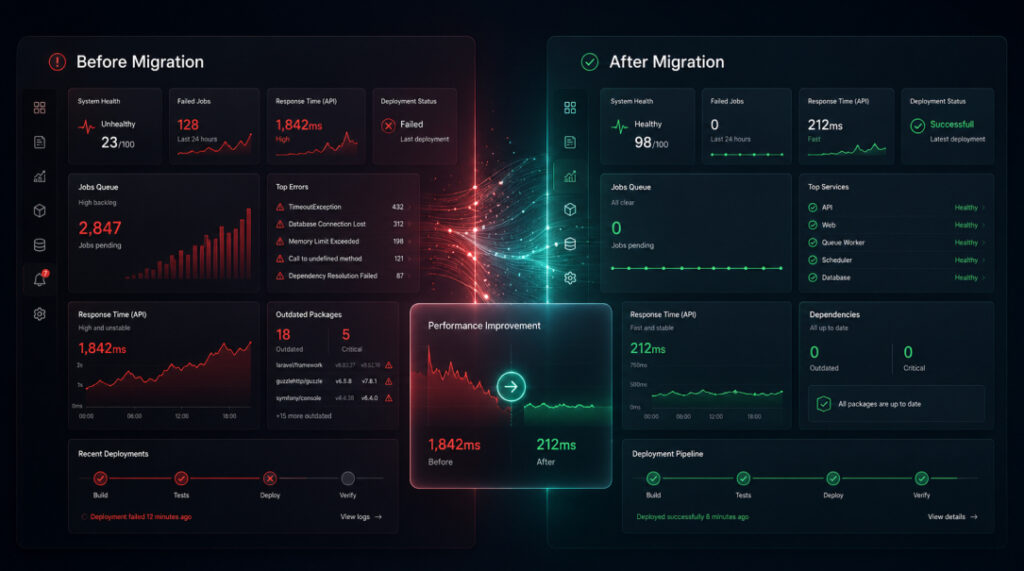
The Versions Nobody Talks About: Laravel 6, 7, and 8
Here is where it gets uncomfortable for enterprise teams. Laravel 6 was released in September 2019 and was the framework’s first LTS release under semantic versioning. Laravel 7 followed in March 2020. Laravel 8 arrived in September 2020. At the time, these felt modern, stable, and more than adequate. Laravel 7 and 8 are no longer supported with security fixes or PHP 8.2+ compatibility. Staying on these versions opens your application to vulnerabilities, slows development, and blocks access to modern tools like Vite, Octane, and typed routes. This creates a compound problem for engineering teams:- You cannot use modern packages that require Laravel 10+
- You cannot adopt PHP 8.2+ features that newer frameworks depend on
- Compliance audits flag EOL software — SOC 2, PCI DSS, HIPAA, and the EU Cyber Resilience Act require organizations to use supported software or demonstrate equivalent compensating controls
- Every sprint spent patching old behavior is a sprint not spent building new capability
So, Who Owns the Laravel Migration?
This is the question that exposes the real problem. In many enterprise environments, the Laravel migration lives in a grey zone. The product team does not own it because it is infrastructure. The Laravel DevOps team does not own it because it is application-layer. The engineering leads do not prioritize it because nothing is visibly broken — yet. Sound familiar? This is what “nobody owns it” looks like in practice. Not chaos. Not negligence. Just a slow, quiet accumulation of risk that nobody has formally taken responsibility for — until a breach happens, a critical package breaks, or a compliance audit surfaces it as a finding. End-of-life risk rarely lives in your top-level packages. It hides in the transitive dependencies woven throughout your open-source stack. When one of those libraries becomes vulnerable, every downstream component must be rebuilt and validated. That rebuild, under pressure, without a migration plan, is where months of downtime and emergency hiring happen.Two Real Scenarios Worth Studying
Scenario A: The Talent Platform That Couldn’t Ship
Imagine a B2B hiring platform — the kind used by mid-market companies to manage recruitment pipelines. Their product has been on Laravel 7 since its launch. The team is competent. The product works. But over eighteen months, they notice something: a new hire Laravel developer takes three weeks to understand the codebase. Modern packages for AI-based resume parsing require Laravel 10+. Their release cycles have slowed from weekly to monthly — not because of product complexity, but because every deployment requires manual regression testing against behaviors that newer framework versions handle automatically. A staged upgrade path across multiple sprints was proposed: freezing the master branch, establishing a clean staging clone, auditing packages, replacing outdated ones, and refactoring authentication flows. The total migration took one quarter. The release velocity returned to weekly within six weeks of completion.Scenario B: The SaaS Dashboard That Failed a Compliance Audit
A financial reporting SaaS — the type that enterprise clients use for quarterly reporting — ran a routine SOC 2 audit. The auditors flagged their Laravel 8 stack as a critical finding. Not because of a breach. Not because of a bug. Simply because they were running software with no active security support. The client asked for a remediation timeline. The company did not have one. They lost the contract. The cost of that lost contract was higher than the entire budget they had been “saving” by deferring the Laravel migration.The Cascade Problem: Why You Cannot Skip Versions
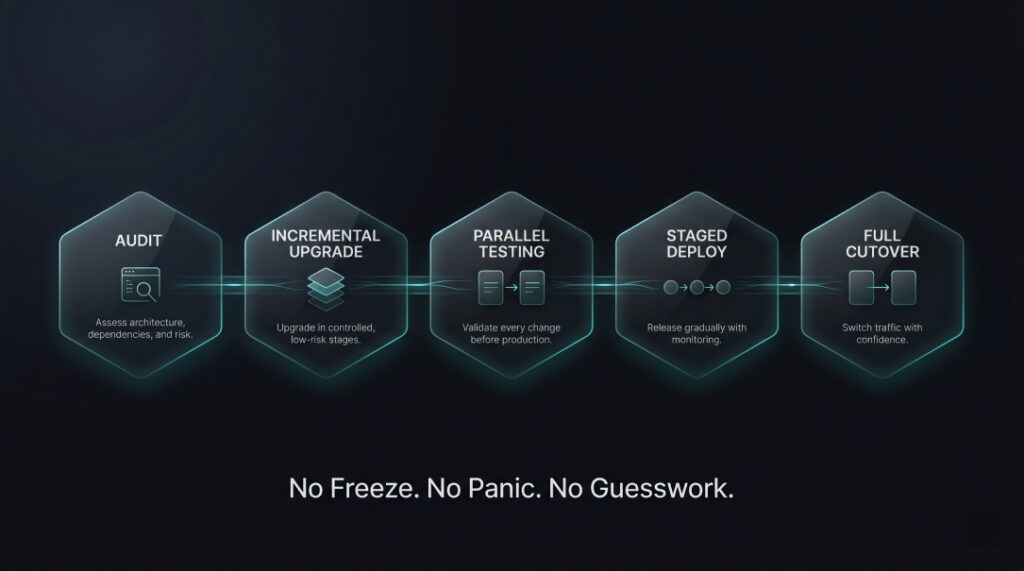
One of the most common misconceptions about Laravel migration is that you can jump from Laravel 8 directly to Laravel 12 or 13. You cannot — not cleanly. Skipping over major versions creates a cascade of problems and multiplies the upgrade complexity exponentially. Organizations should always upgrade through incremental version steps: 6 → 7 → 8 → 9 → 10 → 11 → 12. This is important to understand because it reframes the timeline. A Laravel migration from version 6 to version 12 is not a one-sprint project. It is a structured, phased engineering engagement — one that requires the right expertise, the right tooling, and a clear plan for each version increment. Enterprise applications are often built upon a robust ecosystem of Composer packages and third-party libraries. Upgrading Laravel will often imply upgrading those packages as well — and some may be deprecated, lack a compatible version, or introduce their own breaking changes. Done correctly, each increment is manageable. Done in a rush or by a team unfamiliar with the version-specific breaking changes, it becomes the kind of project that takes months, produces regressions, and ultimately costs more than it saved.What Zero-Downtime Laravel Migration Actually Looks Like
The phrase “zero-downtime migration” gets used loosely. Here is what it means in practice for a Laravel migration: It means your users never experience an outage. It means your database schema changes are backward-compatible at each stage of the upgrade. It means your deployment pipeline is tested in parallel with your production environment before any cutover. And it means rollback is always an option — not a prayer. For a zero-downtime migration, you typically need three phases: first, change the code to not depend on old structures while handling both old and new data formats; second, remove or migrate the legacy data; third, clean up the workarounds from phase one. This is not theoretical. It is how teams like Stripe, GitLab, and other high-reliability engineering organizations approach schema and framework migrations at scale. The same discipline applies to your Laravel migration — regardless of your company size.FAQ: Running Laravel 6, 7, or 8? Here Is What You Need to Know
Q: Is my Laravel 6 or 7 application still “safe” if nothing has broken yet?
A: Safe and supported are different things. Nothing breaking is not evidence of no risk — it is evidence that a risk has not materialized yet. Laravel 6, 7, and 8 have all reached end of life and receive no security patches or bug fixes. The next vulnerability discovered in any of their dependencies will go unpatched.Q: We have heavily customized our Laravel 8 codebase. Does that make migration harder?
A: Yes — but not impossible. Custom macros, overridden internals, and tight package coupling all add complexity to a Laravel migration. The right approach is a pre-migration audit that maps every point of customization against the breaking changes in each version increment. This is precisely where Laracore’s specialization in legacy Laravel versions becomes the difference between a clean migration and an extended production incident.Q: How long does a Laravel migration from version 6, 7, or 8 actually take?
A: It depends on codebase size, test coverage, and package complexity. A well-scoped engagement typically spans two to four months for incremental version upgrades with zero-downtime deployment at each stage. The risk of compression — trying to do it faster — is where most migrations go wrong.Q: Who at Laracore handles migrations from these older versions?
A: This is where Laracore is specifically built for you. Many generalist Laravel shops will attempt a Laravel migration from version 6, 7, or 8 — but few have the institutional knowledge of the specific breaking changes, deprecated helpers, and package behaviors that make these versions uniquely complex. Laracore’s team has navigated this terrain repeatedly. The result is a migration that does not become a six-month regression fire.The Bottom Line for Engineering Leaders
Your Laravel version is not just a technical detail. It is a business risk indicator. The teams that treat it as such — that build a structured Laravel migration plan, assign clear ownership, and execute it in phases — are the ones that avoid the emergency, the audit finding, and the lost contract. The teams that continue to defer it are accumulating a debt that compounds every quarter. The question is not whether you will do this migration. The question is whether you will do it on your terms — or whether a security incident will force the timeline for you. Laracore specializes in zero-downtime Laravel migration for enterprise applications running on versions 6, 7, and 8 — the versions most companies are terrified to touch. If your team has been staring at that Jira ticket, it is time to move it out of the backlog and into a real plan.
Faheem Hasan
With over 12+ years of experience shaping high-performing web and Laravel platforms, Faheem brings strategic expertise and proven stability to enterprise technology environments. At Laracore, he leads the delivery of scalable, performance-driven Laravel solutions designed to support long-term growth and global business demands.
With over 12+ years of experience shaping high-performing web and Laravel platforms, Faheem brings strategic expertise and proven stability to enterprise technology environments. At Laracore, he leads the delivery of scalable, performance-driven Laravel solutions designed to support long-term growth and global business demands.