What Your CFO Approved and What Your CTO Is Quietly Worrying About
Here is a scenario that plays out more often than enterprise leadership wants to admit. A fast-growing SaaS development company — let us call them Clarivo, a B2B analytics platform based in Austin — decided to scale its product development by bringing in a team of freelance developers sourced through a popular talent marketplace. The pitch was straightforward: faster onboarding, lower overhead, and no long-term commitments. Finance loved it. The product roadmap looked achievable for the first time in months. Then the lead freelancer took another project. Another freelancer dropped off mid-sprint without documentation. A critical authentication module began throwing errors. Nobody knew who had written it, nobody owned the fix, and the one person who did know had invoiced their last hour three weeks earlier. Clarivo lost 11 hours of platform access during a peak usage window. 3 enterprise clients escalated to their account managers. One sent a formal SLA breach notice. This is not a startup cautionary tale. It is an enterprise pattern — and it is becoming more common as organizations chase short-term cost efficiency without accounting for the structural risks underneath.Why Does This Keep Happening? The Five Pressure Points No One Talks About
Bugs That Live Longer Than the Contract
When a freelance developer writes a feature and exits the engagement, the knowledge of that code leaves with them. There is no internal tribal knowledge, no documented decision trail, and no one who inherits accountability for what breaks downstream. According to a report from the Uptime Institute’s Annual Outage Analysis, over half of organizations reported that their most recent serious outage cost more than $100,000. For enterprise SaaS platforms where uptime is tied directly to SLA commitments, a single undocumented bug discovered post-departure is not just a technical inconvenience — it is a financial and reputational liability.Downtime That Nobody Anticipated
There is a dangerous assumption buried in most freelance engagements: that the developer understands your production environment as deeply as someone who lives inside it every day. They rarely do. Research tracking DevOps SaaS platforms in 2024 found that popular platforms — including GitHub, Jira, and Azure DevOps — experienced 502 separate incidents resulting in more than 4,755 hours of degraded performance or outages. If enterprise-grade platforms with dedicated engineering teams face this level of exposure, imagine the risk profile of a SaaS product maintained by a rotating cast of freelance contributors who have never met each other.Risky Updates That Skip Review Cycles
A structured engineering team operates within a defined release cycle: code review, staging environments, QA gates, and rollback procedures. Freelancers, by the nature of their engagement model, are often optimizing for speed and output — not process adherence. Consider what happened at a mid-market HR SaaS company — name changed for privacy — when a freelance contractor pushed a dependency update directly to production on a Friday afternoon. The update conflicted with their SSO integration. Payroll access was broken across the weekend for three of their enterprise clients. By Monday morning, two clients had formally requested contract reviews. The developer had already moved to a new project. The internal team spent the weekend reverse-engineering changes they had never been briefed on.Release Cycles That Slow to a Crawl
Enterprise buyers expect predictable delivery. Product roadmap commitments, feature rollout dates, and quarterly business reviews are built on the assumption that your engineering function is stable. The reality of freelance dependency is that availability is never guaranteed. Freelancers manage multiple clients simultaneously. Priorities shift. Response times extend. A feature scoped for a two-week sprint quietly becomes a six-week delay when the developer juggles three other engagements. As a benchmark, enterprise SaaS production-ready platforms typically require between $150,000 and $400,000 in development investment, with post-launch maintenance consuming 15 to 25 percent of ongoing time for updates and scalability. That level of continuous investment demands a continuous team — not a gig workforce. Reference: SolveitDev SaaS Development Cost Breakdown 2025Nobody Owns It — The Accountability Gap
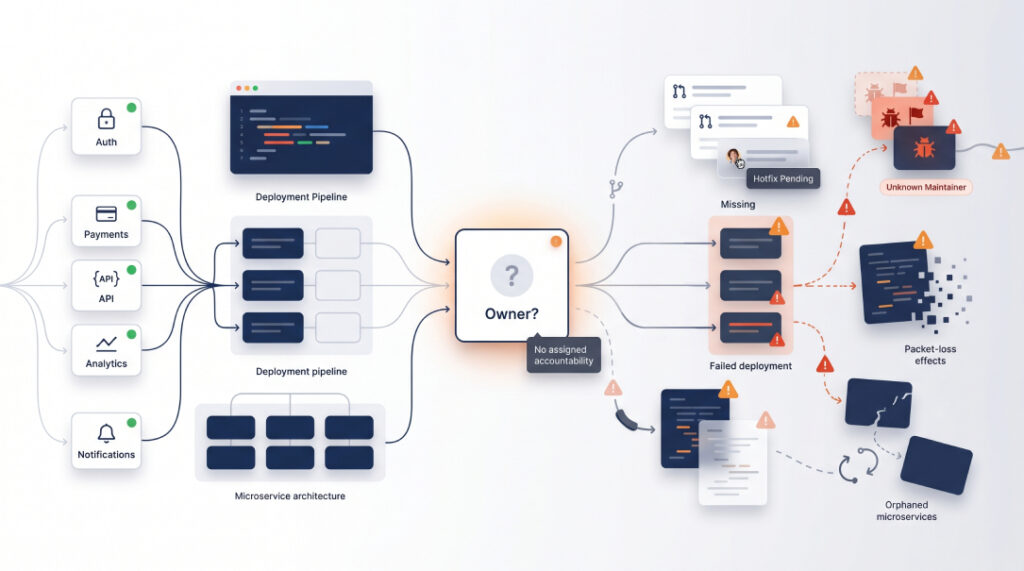 This is the risk that costs enterprises the most and shows up on no invoice. When a codebase passes through multiple freelance contributors — each one writing their section, billing their hours, and exiting — what you are left with is an application without a custodian. Nobody is accountable for the architecture at a macro level. Nobody is monitoring the whole system’s health. Nobody is thinking about what happens in eighteen months when a library reaches end-of-life. The Cloud Security Alliance’s State of SaaS Security 2025 report — based on responses from 420 IT and security professionals surveyed in January 2025 — found that SaaS security continues to be treated as an afterthought, with most organizations relying on tools and strategies not built for the realities of modern SaaS. The report noted that incomplete coverage and inconsistent enforcement are the defining features of how most organizations manage SaaS risk. A fragmented freelance development model is one of the primary contributors to that fragmentation.
The Security Exposure Your Legal Team Has Not Flagged Yet
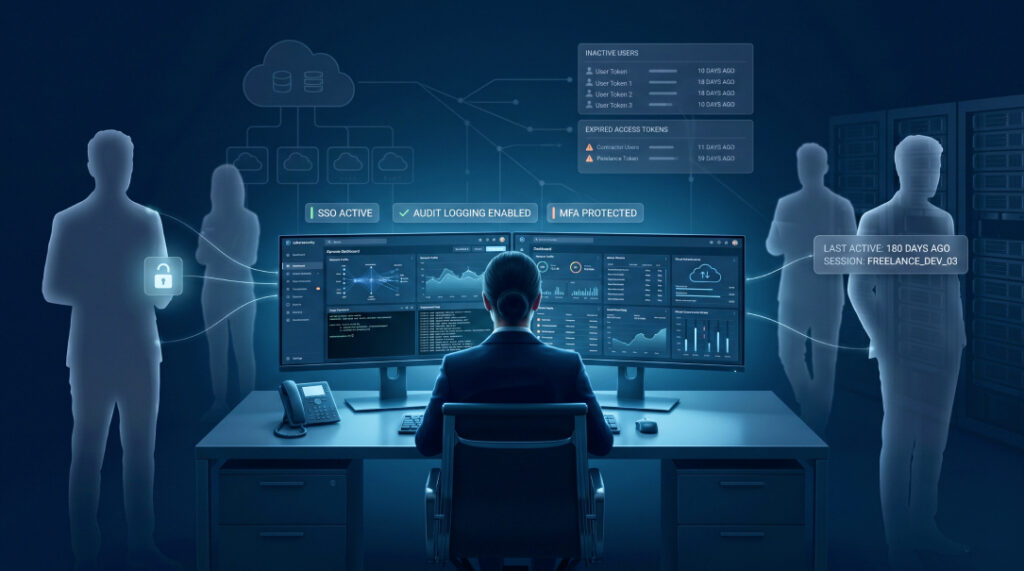 Here is something that should make enterprise security leaders pause. According to the SaaS Security in 2026 research, insider threat prevention is now foundational to enterprise SaaS security. Among the most cited exposure vectors are contractors and freelancers retaining access to data after the engagement ends. The SaaS Application Security Insights 2025 report found that of more than four million SaaS accounts monitored in 2024, more than half — 55.24% — were guest user accounts rather than licensed users. Guest accounts created for contractors and freelancers often persist long after a project concludes, quietly accumulating access to sensitive systems and data. This is not a hypothetical. It is a measurable, documented pattern across enterprise SaaS environments right now.
What the Smarter Enterprise Decision Actually Looks Like
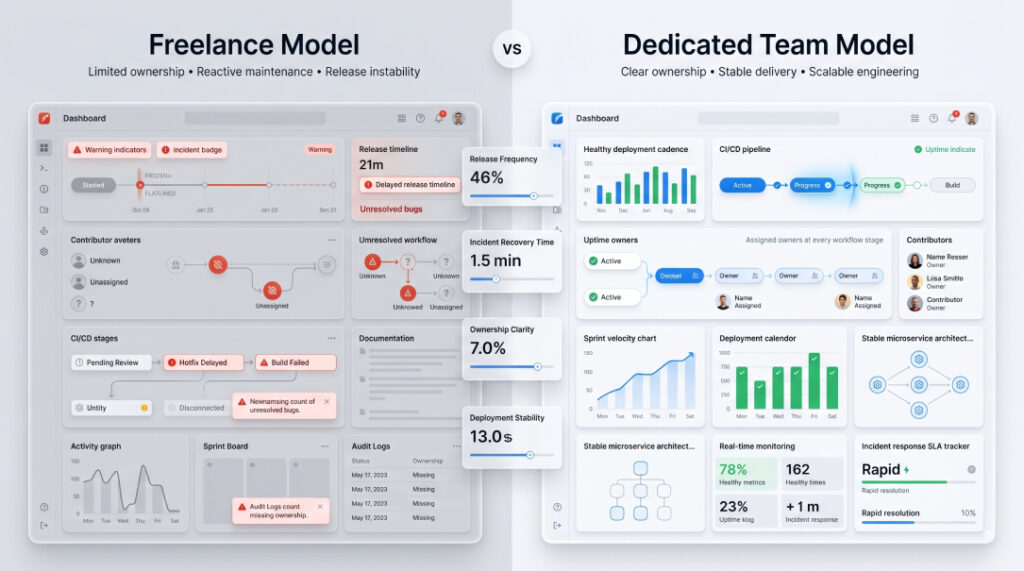
This is not an argument against all forms of flexible development partnerships. The freelance model has a legitimate role in early-stage prototyping, short-term specialized work, and specific isolated feature development. The risk emerges — and compounds — when organizations use the freelance model as the primary development backbone for production SaaS. When there is no dedicated team that owns the codebase end-to-end, accountability dissolves in direct proportion to the number of independent contributors. What enterprise-grade SaaS development actually requires:- A stable, named team with continuous codebase ownership
- Documented architectural decisions and internal knowledge transfer
- SLA-backed release cadences with defined rollback protocols
- Security access governance that terminates with each engagement
- A single point of technical accountability at every stage
The Question Every Enterprise CTO Should Be Asking Right Now
“If my lead freelance developer stopped responding tomorrow, who on my team could fully own the codebase by Monday?” If that question produces hesitation — if the honest answer is “nobody” or “we’d have to start over” — that hesitation is itself the risk indicator that needs addressing. The enterprise clients who have made the switch from freelance-dependent models to dedicated, structured development partnerships consistently report the same outcome: slower starts, faster scaling, and dramatically fewer production incidents that cascade into client-facing crises. The hidden cost of freelance flexibility is the absence of ownership. And in enterprise SaaS, ownership is not optional — it is the entire product.
Faheem Hasan
With over 12+ years of experience shaping high-performing web and Laravel platforms, Faheem brings strategic expertise and proven stability to enterprise technology environments. At Laracore, he leads the delivery of scalable, performance-driven Laravel solutions designed to support long-term growth and global business demands.
With over 12+ years of experience shaping high-performing web and Laravel platforms, Faheem brings strategic expertise and proven stability to enterprise technology environments. At Laracore, he leads the delivery of scalable, performance-driven Laravel solutions designed to support long-term growth and global business demands.